Adlington’s transport infrastructure is fundamentally unsuited to supporting a new town of 50,000+ people without extraordinary and uncertain investment, and the evidence shows that the scale, cost, and dependency on uncommitted national schemes make such an outcome highly unlikely.
Roads
Adlington’s existing roads are served by a single main raid, the A523 (London Road) which runs North-South through the village, and is already heavily congested at peak times as the only route for traffic between Macclesfield, Poynton and Stockport. The rest of the roads throughout Adlington are narrow, rural roads with pinch points, historic bridges, limited visibility and weight restrictions. There is no bypass, all traffic must use the A523 or the local lanes.
The roads were never designed for high volumes of commuter, freight or bus traffic. Many sections lack pavements, lighting or safe cycling infrastructure. There are frequent sections unsuitable for two vehicles to pass and are completely inaccessible to heavy goods vehicles.
Structural Constraints
The constraints are not simply about congestion; they are physical and geometric:
- The A523 is a bottleneck along its entire length, with no realistic space for widening through Poynton, Adlington, or Tytherington.
- Rural lanes cannot be upgraded without major land acquisition, demolition, and environmental impact on the Green Belt and canal corridor.
- Bridge constraints limit both capacity and vehicle size, and replacing them would require canal closures, diversions, or significant heritage mitigation.
- Topography—steep gradients and narrow valleys—restricts the alignment of any new strategic roads.
These are not marginal issues that can be solved with junction tweaks; they are fundamental limitations of the landscape.
What a New Town Would Require
A settlement of 14,000–20,000 homes would generate tens of thousands of daily vehicle movements, even under optimistic assumptions about public transport use. To function safely and reliably, the road network would require:
- A new north–south strategic route capable of carrying commuter and freight traffic.
- Multiple new junctions connecting the development to the A523 and surrounding settlements.
- A full distributor road network within the new town, linking to external routes without funnelling all traffic through Adlington village.
- Major upgrades to the A523 through Poynton and Tytherington, including widening, junction reconstruction, and potentially grade separation.
- New bridges over the canal and River Dean to create additional access points.
- Significant bus priority infrastructure, requiring road widening and land take.
These interventions would be on a scale comparable to the Crewe Green Link Road, Poynton Relief Road, or A6–Manchester Airport Relief Road, each of which cost tens to hundreds of millions of pounds and required years of planning, compulsory purchase, and environmental mitigation.
Why This Is Unlikely to Happen
1. Cost and Deliverability
Major road schemes in Cheshire East and Greater Manchester routinely cost between £30 million and £200 million, even for relatively short links. A new strategic route through Adlington would require:
- Land acquisition across Green Belt and farmland.
- Bridge construction over the canal and river.
- Extensive earthworks due to topography.
- Environmental mitigation for protected habitats.
These factors push costs into the territory of nationally significant infrastructure, far beyond what a single development could fund.
2. Environmental and Heritage Constraints
The Macclesfield Canal is a Grade II listed structure, and its corridor is protected. Any new crossings or road widening would face:
- Heritage objections.
- Canal & River Trust engineering constraints.
- Ecological impacts on the Dean Valley and surrounding woodlands.
These constraints make large‑scale road building slow, expensive, and uncertain.
3. A523 Capacity Is Already Exhausted
The A523 is one of the most congested A‑roads in Cheshire East, with:
- Peak‑hour queues through Poynton and Tytherington.
- Limited opportunities for widening.
- High accident rates at several junctions.
- Strategic dependence on the A6–Manchester Airport Relief Road and Stockport’s network, which are themselves constrained.
Adding thousands of additional daily trips would worsen congestion not only in Adlington but across the entire corridor.
4. Local and Regional Policy Conflicts
Cheshire East’s Local Transport Plan and Greater Manchester’s transport strategy both emphasise:
- Reducing car dependency.
- Avoiding developments that generate large volumes of new traffic.
- Protecting the Green Belt and canal corridor.
A car‑dependent new town in Adlington contradicts these policies and would require exceptional justification.
Rail
Adlington’s rail infrastructure is fundamentally unsuited to supporting a new town of 55,000+ people without extraordinary and uncertain investment, and the evidence shows that the scale, cost, and dependency on uncommitted national schemes make such an outcome highly unlikely.
Existing Rail Infrastructure at Adlington
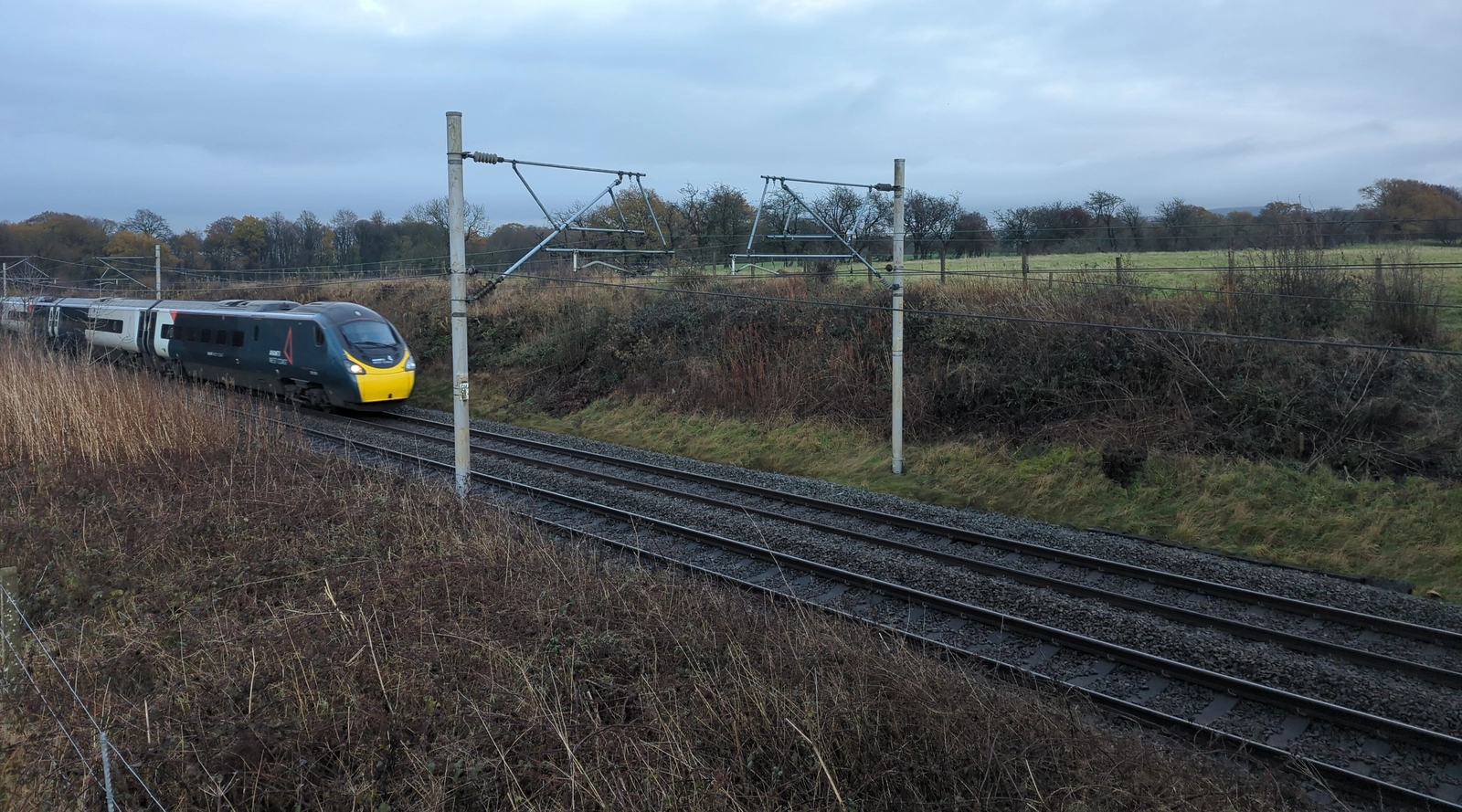
Adlington station is a small, unstaffed platform halt on the Stafford–Manchester line, a feeder route of the West Coast Main Line (WCML). It currently has no passing loops, minimal parking, and no staffed facilities. Passenger usage is modest—around 25,000 entries and exits per year—reflecting its role as a rural village stop rather than a strategic transport hub 1.
Crucially, the line through Adlington is mixed‑traffic. Slow Northern stopping services share the same two tracks with Avanti West Coast and CrossCountry express trains, as well as freight. Network Rail has repeatedly identified this corridor—particularly the southern approach to Manchester via Stockport—as capacity‑constrained, with little flexibility to add new stopping services without displacing long‑distance or freight paths 2.
Because stopping trains decelerate, dwell, and accelerate, each additional stop creates a “pathing conflict” with faster services. Even increasing Adlington’s service from hourly to half‑hourly would materially interfere with express operations unless major infrastructure changes were made. This is not a marginal issue but a structural one inherent to the two‑track layout.
What a New Town Would Require
A new town of 14,000–20,000 homes (around 50,000–55,000 residents) would require Adlington to function at a scale comparable to Macclesfield or Crewe, handling over a million passengers per year. To do so safely and reliably, several major upgrades would be unavoidable:
- Half‑hourly or better services in both directions, requiring additional train paths.
- Passing loops or four‑track sections through or near the station so stopping trains do not block expresses.
- Full station reconstruction, including staffed buildings, step‑free access, ticket gates, and crowd‑management infrastructure.
- Large‑scale parking and bus interchange facilities, likely hundreds of spaces, to serve a wide catchment.
Network Rail has repeatedly highlighted that infrastructure works on the West Coast Main Line carry exceptionally high costs due to disruption and operator compensation liabilities. In its West Coast Main Line Route Studies, Network Statements, and enhancement appraisals, Network Rail identifies the WCML as one of the most intensively used mixed‑traffic railways in the country, where extended possessions trigger substantial Schedule 4 and Schedule 8 compensation payments to passenger and freight operators. These factors are consistently cited by Network Rail as a major constraint on the affordability and deliverability of additional tracks, passing loops, or station works on the route, particularly where schemes are intended to support local service improvements rather than nationally strategic capacity increases.
Why This Is Unlikely to Happen
The principal barrier is cost and deliverability. Published UK rail cost benchmarks show that even modest infrastructure works on operational lines routinely cost tens of millions of pounds. For example, the Metrowest Phase 1 upgrade in Bristol, which included new track, signalling and station works, reached £55 million, while Phase 2 was costed at £42 million. These figures illustrate the scale of expenditure typically associated with enhancements on live rail corridors, even before accounting for the additional complexity of high‑speed turnouts, electrification modifications, or land acquisition 3.
Recent UK station projects show that even relatively modest upgrades routinely cost tens of millions of pounds, demonstrating how significant the bill for an Adlington rebuild would be. For example, the new Golborne station in Greater Manchester is budgeted at £32 million for two platforms, step‑free access and a small station building, while Marsh Barton in Exeter opened in 2023 at £34 million for similar works. The White Rose station in Leeds cost £26 million, and the rebuild of Perry Barr in Birmingham exceeded £30 million. These schemes did not require major track realignments or passing loops, meaning any upgrade at Adlington involving full station reconstruction, and potential capacity works on the West Coast Main Line would inevitably be far more expensive.
Equally important is strategic dependency. Many arguments for feasibility rely on the proposed Midlands–North West Rail Link (MNWRL), which would divert high‑speed trains away from the WCML and free capacity for local services. While land has been safeguarded and development funding allocated, this scheme is not approved, not funded for construction, and not expected to open until the mid‑2030s at the earliest. Until then, Network Rail has warned that adding frequent stops at Adlington is operationally unacceptable.
In the absence of MNWRL, the only alternative is localised heavy engineering through the village—widening embankments, rebuilding bridges, and closing the WCML for extended possessions. Network Rail has highlighted the high compensation costs and disruption associated with such works on Britain’s busiest mixed‑traffic railway 4.
Finally, there is a governance issue. Cheshire East Council has already cited these rail constraints as a core reason for opposing the new town , noting that the transport strategy depends on “unrealistic” levels of rail investment that are neither committed nor proportionate to the location.
Conclusion
Taken together, the evidence from both road and rail shows that Adlington’s transport infrastructure is not simply undersized but structurally incompatible with the demands of a 55,000‑person new town. On the rail side, the village sits on a constrained two‑track mixed‑traffic corridor where additional stopping services, longer trains, or major station upgrades are only feasible if transformative national schemes—such as the Midlands–North West Rail Link—are delivered. Without those projects, the railway would be overwhelmed, and the scale of investment required to make it fit for purpose is economically and politically implausible.
The road network faces equally immovable limits. A single congested A‑road, narrow rural lanes, heritage canal crossings, and restrictive topography mean that the highway system cannot absorb the tens of thousands of daily vehicle movements a new town would generate. Delivering the necessary new strategic routes, bridges, and junctions would require large‑scale land acquisition, major environmental impacts, and costs on the scale of national infrastructure—none of which are committed, funded, or aligned with local or regional transport policy.
Viewed objectively, this is not resistance to growth in principle. It is a recognition that both the road and rail networks impose hard physical, operational, and financial limits that planning policy cannot wish away. Without guaranteed delivery of transformative national transport schemes—and without the ability to re‑engineer the local landscape at vast cost—Adlington cannot support a development of this magnitude.