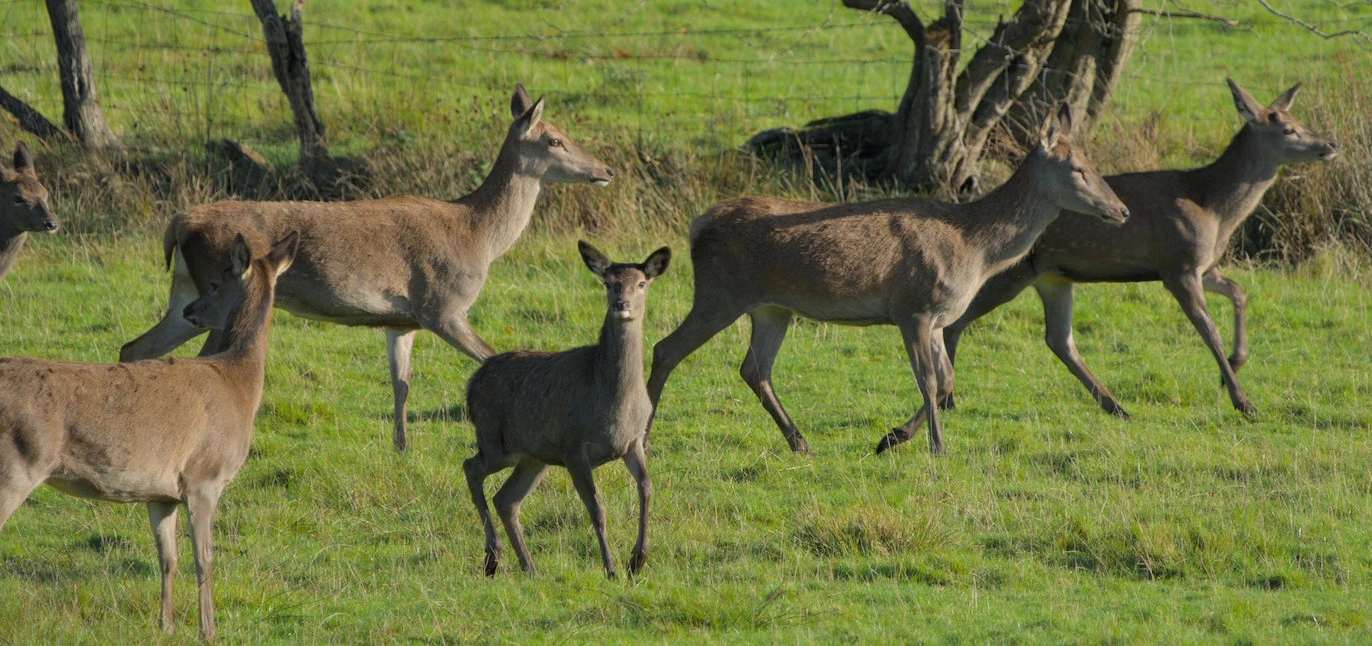
Adlington’s natural habitats and wildlife
The area around Adlington contains a rich and varied landscape: small irregular fields with tall hedgerows, in-field trees, scattered ponds, meadows, streams and woodlands. According to the Cheshire Wildlife Trust (CWT), Adlington has close to triple the woodland coverage of the Cheshire average and a particularly high number of woodland patches between fields and along brooks 1.
This landscape supports a wide variety of wildlife. Ancient and semi-natural woodlands provide habitat for woodland birds, mammals, insects, fungi and native woodland flora. Farmland and hedgerows offer nesting and feeding sites for farmland birds like lapwing, and corridors for pollinators and small mammals. Ponds, streams and riparian (area between land and a river or stream) strips support amphibians, aquatic insects and other species dependent on wet or damp habitats. Local reporting has identified species such as the rare lesser spotted woodpecker, woodland flowers, farmland birds and amphibians all using these habitats 1 2.
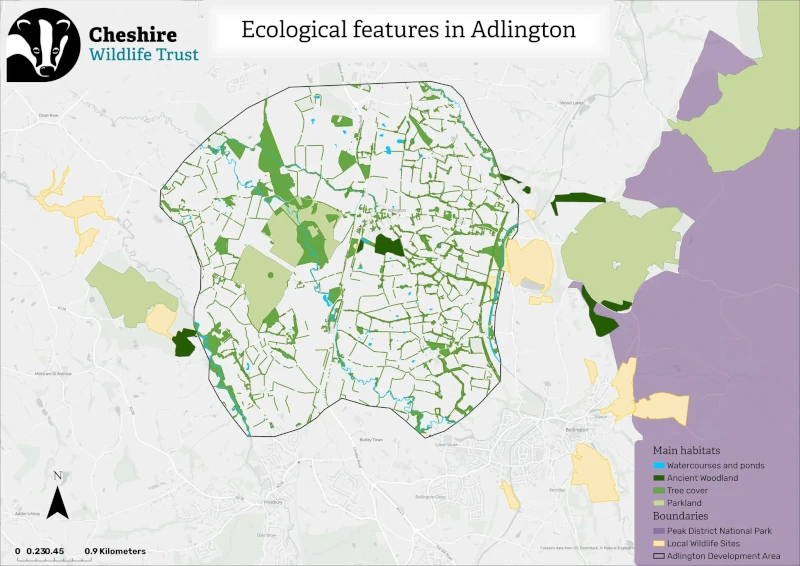
Importantly, these habitats connect across the landscape. Hedgerows, woodlands and waterways form a network that links the foothills of the Peak District National Park with the lower-lying Cheshire Plain. This connectivity allows wildlife to move, feed and reproduce across a broad area rather than being confined to isolated patches 3.
What would be lost under the new-town proposal
The proposed Adlington New Town would place around 14,000–20,000 new homes on roughly 1,000 hectares of mostly greenfield land. This would almost certainly destroy or fragment large parts of the existing habitat network 4 5.
Woodlands, hedgerows, in-field trees, ponds, streams and meadow areas would be replaced by housing and infrastructure. Such a change would break habitat connections, removing corridors wildlife relies on for migration, foraging and breeding. Species dependent on woodland, farmland, hedgerow, wetland or riparian habitats would lose vital homes.
The Myth of “Biodiversity Net Gain”
Developers promise “biodiversity net gain”, claiming that for every mature tree felled, new saplings will be planted nearby. Experts say this is a dangerous misconception that disguises permanent environmental damage behind a façade of green language 6. Under current planning rules, councils must consider biodiversity and sustainability when approving major developments 7. Developers exploit this by presenting plans full of tree-planting schemes and landscaped green spaces, arguing that any lost woodland will be “replaced.” On paper, that sounds reassuring. In reality, it’s little more than a box-ticking exercise. “We’re not really losing trees; we’re replacing them with new ones” developers say. The truth is: you can plant trees, but you can’t plant time. “Habitat creation” is a term used by the developer’s marketing team to appear environmentally friendly and ecologically sympathetic, to meet the council’s requirements in their application. Mature woodland is a living system, not just a collection of trees. It provides flood protection, soil stability, water purificaƟon, shade, biodiversity, and carbon storage, functions that saplings can’t replicate for decades, if ever 8.
Why Adlington deserves protection
Adlington is not just farmland awaiting development. It is a living ecosystem, with a complex and interwoven web of habitats that sustain diverse wildlife and allow natural processes — pollination, water regulation, species dispersal — to function across the landscape.
Destroying or fragmenting this network would not only eradicate many species locally but also diminish long-term ecological resilience and the natural heritage of the area. For these reasons the New Town proposal should be viewed as incompatible with the ecological value of Adlington.