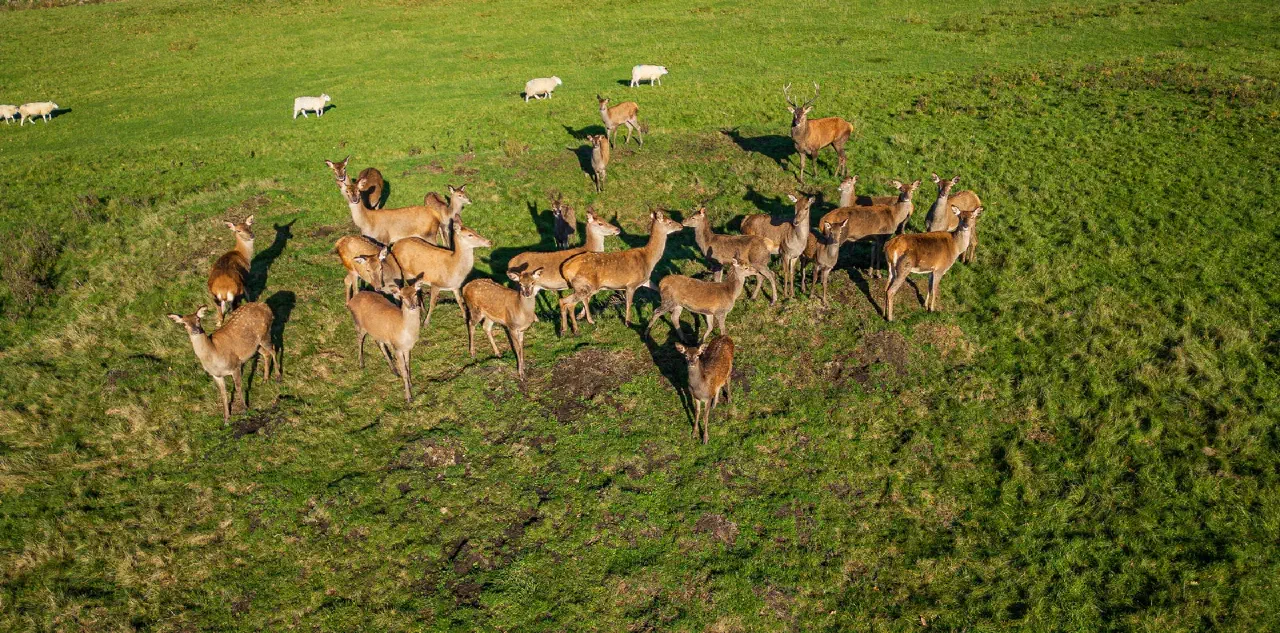
The land proposed for Adlington Park is not an empty development site. It is part of an established countryside landscape that already supports wildlife and provides important connections between habitats.
The proposed development area contains a network of fields, hedgerows, mature trees, ponds, streams and other habitats. These features work together rather than existing in isolation, providing places for wildlife to feed, shelter, breed and move through the landscape.
A home for wildlife
The fields and hedgerows around the proposed Adlington Park site provide habitat for a wide range of farmland and woodland species. Mature trees can provide nesting and roosting opportunities for birds and bats, while hedgerows provide food, shelter and important routes for wildlife to move between habitats.
The ponds and wet areas are particularly important because they can support amphibians and other aquatic and terrestrial wildlife. Great crested newts are a protected species known to occur in the wider Adlington area, and Cheshire East’s planning evidence recognises the importance of ponds and surrounding terrestrial habitat when assessing development proposals.
The wider countryside also supports species such as bats, badgers, hedgehogs, farmland birds and owls. These species depend on a functioning network of habitats rather than a collection of isolated wildlife features.
The wildlife corridors matter
One of the biggest concerns about Adlington Park is not simply the loss of individual trees, hedgerows or fields. It is the potential fragmentation of the wider habitat network.
Hedgerows, streams, ponds and woodland allow wildlife to move through the landscape. Removing or breaking these connections can make it harder for animals to reach feeding, breeding and sheltering areas.
This is particularly important for bats, which can use tree lines, hedgerows and waterways as commuting and foraging routes. Cheshire East planning evidence specifically recognises the need to consider bats where development could affect woodland, water or suitable trees.
Existing wildlife cannot simply be replaced
A new development may include tree planting, ponds, bird boxes and other ecological features, but these cannot necessarily replace the value of established habitats.
A mature hedgerow, ancient tree or established pond has developed over many years. Once removed or significantly disturbed, the ecological function it provides cannot simply be recreated overnight.
This is why the priority should be to avoid the loss of important existing habitats wherever possible.
Biodiversity Net Gain is intended to leave habitats in a measurably better state, but Cheshire East’s own guidance confirms that developers should seek to deliver biodiversity improvements on site first. It should not be used as an excuse to treat existing wildlife habitat as disposable.
Protect Adlington’s wildlife
Adlington Park would place significant pressure on an existing wildlife-rich landscape.
We believe the starting point should be to understand and protect the wildlife that is already here, including the habitats and ecological corridors on which it depends.
Before any development is considered, comprehensive and up-to-date ecological surveys should establish what species and habitats are present across the whole proposed site and how they connect to the surrounding countryside.
That should include, where appropriate, detailed assessment of:
- bats and bat roosting, commuting and foraging habitat
- great crested newts and other amphibians
- nesting and farmland birds
- badgers and other mammals
- hedgehogs and other small mammals
- mature and veteran trees
- hedgerows and their ecological value
- ponds, streams and wetland habitats
- reptiles and invertebrates
- wildlife corridors and habitat connectivity
Adlington’s wildlife is already here. The question should not simply be how much of it can be replaced after development. The question should be whether development on this scale is compatible with protecting the functioning landscape and wildlife network that already exists.